

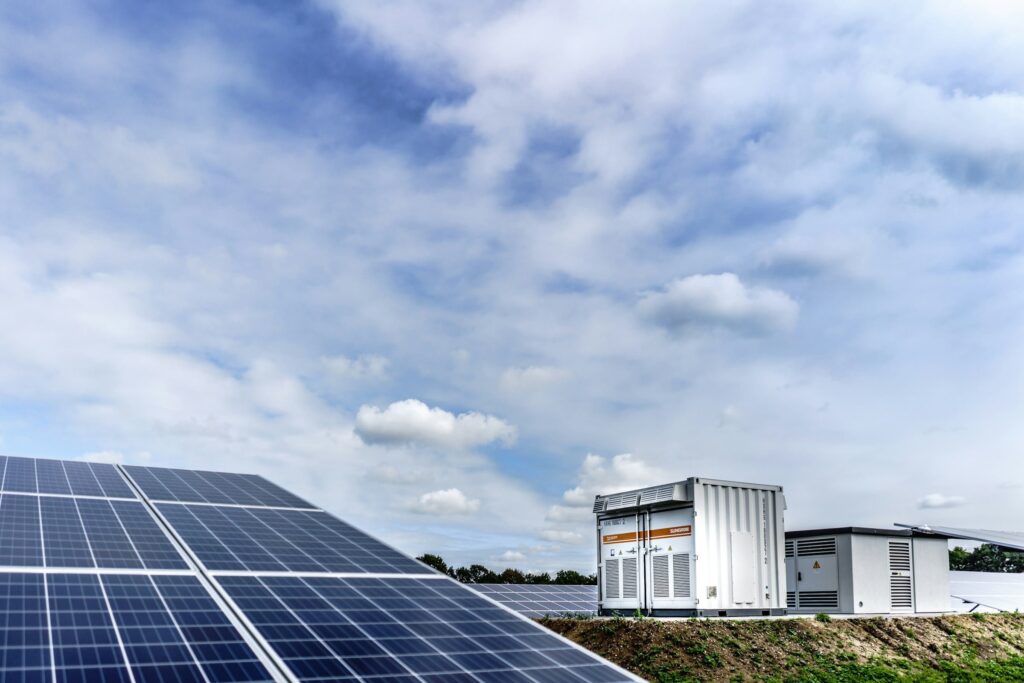
As solar and wind make up a growing share of electricity generation, energy storage has gone from a niche technology to one of the most important pieces of the entire clean energy transition. Storage solves the fundamental problem of intermittency, letting grids bank excess renewable energy when it’s abundant and release it later when generation drops or demand spikes.
Why Storage Matters So Much
Electricity has traditionally needed to be generated at almost the exact moment it’s used, since large-scale storage was historically expensive and limited. That worked reasonably well with fossil fuel and nuclear plants, which can be ramped up or down somewhat on demand, but it becomes a much bigger challenge with solar and wind, which generate power on nature’s schedule rather than the grid’s. Storage breaks that constraint, effectively turning variable renewable generation into a more flexible, dispatchable resource.
Battery Storage
Lithium-ion batteries, the same core technology used in electric vehicles and consumer electronics, currently dominate grid-scale energy storage due to their falling costs, high efficiency, and fast response times. Battery storage installations range from small home battery systems paired with rooftop solar to massive grid-scale installations that can power tens of thousands of homes for several hours. Costs have fallen sharply over the past decade, though batteries still lose economic viability for very long-duration storage, measured in days rather than hours, since more capacity is needed and the batteries currently on the market are optimized for shorter discharge windows.
Beyond Lithium-Ion: Other Storage Technologies
- Pumped hydro storage, the oldest and still largest form of grid storage worldwide, pumps water uphill into a reservoir when electricity is abundant and releases it downhill through turbines when power is needed.
- Compressed air energy storage uses surplus electricity to compress air into underground caverns, releasing it later to drive turbines.
- Flywheel storage spins a heavy rotor at high speed, storing energy kinetically and releasing it quickly, useful for short bursts of grid stabilization.
- Thermal storage stores energy as heat, in molten salt, for example, often paired with concentrated solar power plants to extend electricity generation after the sun sets.
Grid-Scale Versus Home Storage
Utility-scale battery installations help grid operators balance supply and demand across an entire region, smoothing out the variability of large solar and wind farms. Home battery systems, often paired with rooftop solar, give individual households more control over their own energy use, storing daytime solar generation for use in the evening, and in some cases providing backup power during outages.
The Future of Energy Storage
Battery costs are expected to continue falling as manufacturing scales up and technology improves, extending storage’s economic viability to longer durations. A range of alternative battery chemistries, along with technologies like green hydrogen for long-duration storage, are also being developed to fill in the gaps that lithium-ion batteries handle less efficiently. As storage becomes cheaper and more widespread, it’s increasingly viewed not as a supplement to renewable energy but as an essential piece of infrastructure that determines how much solar and wind a grid can reliably support.